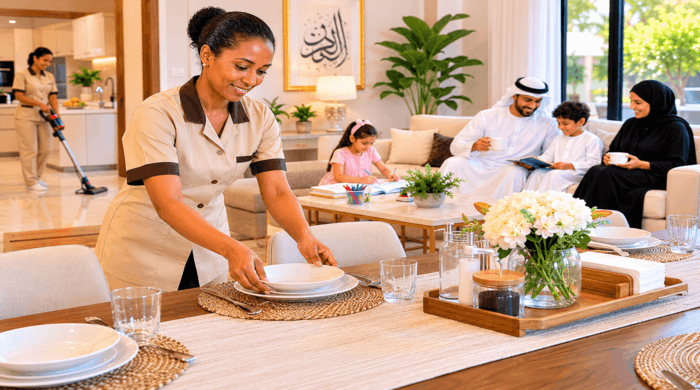

A successful school day starts long before children walk through the school gates.
For families in Qatar, mornings may involve uniforms, breakfast, school bags, lunch boxes, transport, and getting several family members ready at the same time. After school, another routine begins with meals, changing clothes, homework, activities, and preparation for the following day.
A maid can make this daily cycle easier, but only when everyone understands their responsibilities.
The goal is not for the maid to manage the children's entire school routine. Parents remain responsible for school communication, academic decisions, transport arrangements, and their children's overall needs.
Instead, domestic support can keep the practical side of the household organized.
A reliable maid agency can help families find domestic workers whose experience matches their household needs, but a smooth school-day routine still depends on clear organization at home.
A useful way to think about the school day is as one connected cycle:
Morning → School Hours → After School → Homework → Evening → Preparation for Tomorrow
When each stage prepares for the next, families spend less time solving the same small problems every day.
🏠 Why a School-Day Routine Matters for the Whole Family
School affects much more than the hours children spend in the classroom.
It influences when the household wakes up, when breakfast is prepared, which clothes need to be clean, when meals are served, when laundry must be completed, and how evenings are organized.
Without a consistent system, small household tasks can quickly become daily sources of stress.
A clear routine gives parents, children, and the maid a better understanding of what needs to happen and when.
⏰ Small Delays Can Affect the Entire Day
A missing sock may seem unimportant.
So might an unwashed lunch box or a school bag left in the wrong room.
But at 6:30 or 7:00 in the morning, several small problems happening together can delay the whole family.
Common causes of rushed mornings include:
-
Uniforms that were not prepared the night before.
-
Missing shoes or school items.
-
Lunch boxes that still need cleaning.
-
Breakfast starting too late.
-
PE clothes that were forgotten in the laundry.
-
Children searching for belongings around the house.
-
Parents giving last-minute instructions to the maid.
The solution is usually not to make everyone move faster.
It is to move predictable tasks out of the morning whenever possible.
🤝 A Clear Routine Reduces Repeated Instructions
If the maid receives the same instructions every morning, those responsibilities have not yet become a real routine.
For example, parents should not need to say every school night:
"Wash the uniform."
"Prepare the shoes."
"Clean the lunch box."
"Make sure the breakfast items are ready."
Once expectations are established, recurring responsibilities should become part of the normal household system.
Families already working on managing a live-in maid can apply the same principle to school days: establish clear recurring responsibilities instead of managing every task individually.
This reduces repeated instructions for parents and gives the maid more confidence in organizing familiar responsibilities.
👨👩👧 Parents and the Maid Need Different Responsibilities
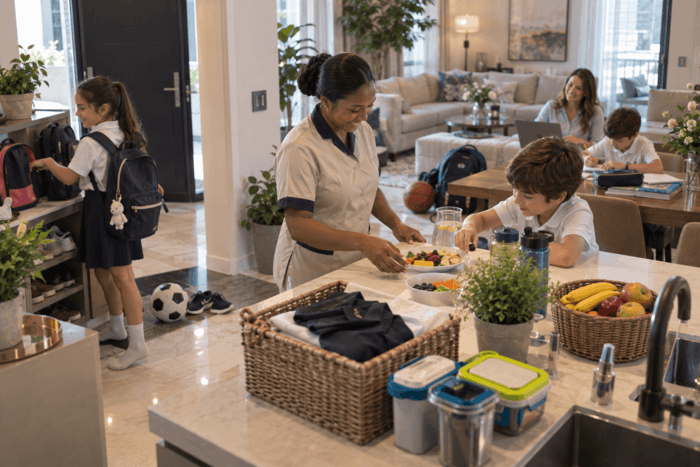
A smooth routine depends on cooperation, but cooperation does not mean everyone has the same role.
Parents should remain responsible for areas such as:
-
School communication.
-
Academic progress.
-
Important school notices.
-
Transport decisions.
-
Changes to schedules.
-
Permission forms.
-
Activities and appointments.
-
Decisions involving the child's health or wellbeing.
The maid can support the practical household tasks around those responsibilities.
For example, parents decide that a child needs a PE kit on Monday.
The maid can make sure the agreed PE clothes are clean and ready.
Parents decide what the child should take for lunch.
The maid may help prepare the lunch box according to those instructions.
This distinction keeps responsibilities clear.
💡 Key Point: The maid supports the school-day system. She should not become the person responsible for managing the child's education or making parental decisions.
🌅 Build a Predictable Morning Routine
The best school mornings are usually simple.
Children know what they need to do.
Parents know which decisions require their attention.
The maid knows which household tasks are already part of her routine.
Reducing unnecessary decisions makes the morning easier for everyone.
👕 Uniforms Should Be Ready Before Morning
School uniforms should ideally be prepared before the family goes to bed.
Depending on the school and child's schedule, this may include:
-
Shirt, dress, trousers, or skirt.
-
Socks.
-
Shoes.
-
PE uniform.
-
Sports shoes.
-
Sweater or jacket when needed.
-
Activity-specific clothing.
The maid can support this process through regular laundry and uniform preparation as part of the family's agreed housemaid services.
However, parents should communicate schedule changes clearly.
If Tuesday requires a PE kit instead of the regular uniform, the maid needs that information early enough to prepare it.
A simple rule helps:
Do not discover tomorrow's clothing requirements tomorrow morning.
🍳 Keep Breakfast Simple and Consistent
School mornings are easier when breakfast does not require a new plan every day.
Families can choose several familiar options that are practical on school days.
The maid may help by:
-
Preparing agreed breakfast items.
-
Setting out basic tableware.
-
Keeping frequently used ingredients available.
-
Cleaning the kitchen after breakfast.
-
Preparing agreed lunch-box items.
Parents remain responsible for deciding what their children should eat and communicating dietary requirements.
The maid's role is to make the practical preparation more consistent.
🎒 Create One Place for School Essentials
Children should not have to search the entire home for their belongings each morning.
Choose one practical area for frequently used school items.
It might contain:
-
School bags.
-
Shoes.
-
Lunch boxes.
-
Water bottles.
-
Activity bags.
-
Jackets.
-
Other daily essentials.
Older children can be responsible for returning their own belongings to this area.
The maid can help keep the space organized and notice obvious items that have been left elsewhere.
This creates a simple habit:
Use it → Return it → Find it easily tomorrow.
🚪 Set a Clear “Ready to Leave” Routine
The final minutes before leaving should involve checking essentials, not completing unfinished household tasks.
A simple division of responsibilities can help:
| Stage | Child | Maid | Parent |
|---|---|---|---|
| Wake-up | Wash and get dressed | Prepare agreed breakfast | Supervise routine |
| Before school | Eat and collect belongings | Support practical preparation | Check important requirements |
| Final check | Shoes, bag, lunch box | Confirm prepared items are ready | Manage transport and school needs |
| Departure | Take personal belongings | Begin household reset | Leave with or supervise child |
The exact routine will differ between families.
What matters is that everyone knows their role before the busiest part of the morning begins.
🏫 Use School Hours to Reset the Home
Once the children leave, the household moves into a different phase.
These quieter hours are useful for completing tasks that would be more difficult when children are home.
Instead of treating the entire school period as general cleaning time, the maid can organize her work around what the family will need later that day and the following morning.
A structured daily routine is also easier to maintain when responsibilities follow a familiar pattern. Looking at a typical day in the life of a full-time maid can help families understand why realistic task sequencing matters.
🧺 Handle Uniforms and Priority Laundry
School clothing should enter the laundry cycle quickly.
If uniforms are left in bags, bedrooms, or different laundry baskets, it becomes easier to discover too late that an essential item is still dirty.
A simple system is:
Used → Laundry → Wash → Dry → Prepare → Ready
PE clothes and activity uniforms may need particular attention because they are not necessarily worn every day.
The maid should know which items are needed next and prioritize laundry accordingly.
🧹 Complete the Main Household Tasks
School hours are also a practical time for routine household work.
This may include:
-
Cleaning bedrooms.
-
Resetting bathrooms.
-
Laundry and ironing.
-
Cleaning common areas.
-
Kitchen work.
-
General household organization.
The goal is to complete the main tasks before the household becomes busy again.
This makes it easier to shift attention toward the afternoon routine when children return.
🍲 Prepare for the Afternoon
A useful school-hours routine should look ahead.
Before children arrive home, the maid may prepare:
-
The agreed lunch or afternoon meal.
-
A simple snack.
-
The dining area.
-
Clean clothes for activities.
-
Items needed later in the day.
This reduces the number of tasks that begin at exactly the same moment children walk through the door.
🛏️ Reset Children’s Rooms and Shared Areas
Children often return home with bags, shoes, uniforms, books, and activity equipment.
If their rooms and shared areas are already cluttered, the afternoon becomes harder to organize.
A basic reset during school hours can make a difference.
Beds can be arranged.
Laundry can be removed.
Frequently used surfaces can be cleared.
School-related storage areas can be returned to order.
The home is then ready for the next stage of the school day rather than still recovering from the previous one.
🏡 Create a Simple After-School Routine
The school day does not end when children arrive home.
The first hour after school can quickly become busy. Children may arrive with bags, lunch boxes, used uniforms, homework, and activity equipment while also wanting food and time to relax.
A predictable sequence makes this transition easier.
A simple routine can be:
Arrive → Put Away → Eat → Rest → Homework or Activities
Children, parents, and the maid should each know their part in this sequence.
🎒 Give School Items a Fixed Place
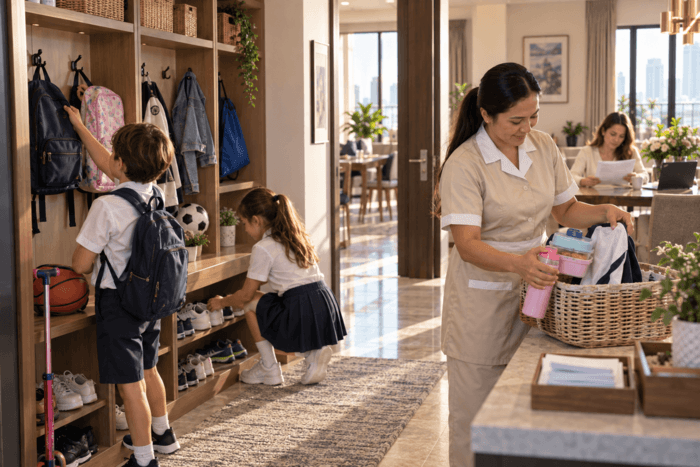
School bags should have a regular place when children return home.
The same principle can apply to:
-
Shoes.
-
Lunch boxes.
-
Water bottles.
-
PE bags.
-
Activity equipment.
-
Jackets.
-
School papers that parents need to review.
Children should gradually learn to put their belongings in the correct places themselves.
The maid can support the system by keeping these areas organized and dealing with items that require household attention, such as lunch boxes or clothes for washing.
This prevents the afternoon routine from creating problems for the following morning.
🍎 Prepare a Simple Meal or Snack
Children often return from school hungry.
Having the agreed meal or snack ready can make the transition home calmer.
Depending on the family's routine, the maid may:
-
Prepare the agreed food.
-
Set the dining area.
-
Fill water when needed.
-
Clear dishes afterward.
-
Reset the kitchen.
Families do not need complicated school-day meals.
Consistency is usually more useful than variety during busy weekdays.
Parents can decide the meal plan, while the maid handles the agreed practical preparation.
👕 Deal with Uniforms Immediately
Used school clothes should have a clear destination.
Children can change and place their uniforms in the designated laundry area rather than leaving clothes on beds, chairs, or floors.
The maid can then identify what needs to be washed for the next school day.
This becomes particularly important when children have only one or two sets of certain items.
PE clothes should also return directly to the laundry cycle after use.
Leaving this until later increases the chance that something important will still be dirty when it is needed again.
😌 Give Children Time to Reset
Not every child is ready to begin homework immediately after arriving home.
Some may need time to eat, change clothes, talk to their parents, or simply relax.
The household routine should allow for this.
The maid can complete practical tasks around the children without turning their return home into another rushed period.
Parents can decide when homework, activities, or other responsibilities should begin.
💡 Key Point: A good after-school routine does not require the maid to manage the children constantly. It creates an organized environment that makes the next part of their day easier.
📚 Support Homework Without Making the Maid the Teacher
Homework can become a source of confusion when responsibilities are not clearly defined.
A maid may be able to support the practical environment around homework.
That does not automatically make her responsible for teaching the child, checking academic accuracy, or monitoring school performance.
Those responsibilities remain primarily with parents, children, and the school.
🪑 Prepare a Suitable Homework Space
A consistent homework area can reduce distractions and wasted time.
Before homework begins, the maid can help ensure that the agreed space is:
-
Clean.
-
Uncluttered.
-
Ready to use.
-
Free from unnecessary household items.
If the child regularly studies at a desk or dining table, that area should not need a complete reset every afternoon.
The goal is to make starting homework easy.
✏️ Keep Basic School Supplies Available
Frequently used supplies can be kept in one organized location.
Depending on the child's age, these might include:
-
Pencils.
-
Erasers.
-
Sharpeners.
-
Rulers.
-
Paper.
-
Coloring materials.
-
Other basic supplies.
Older children should increasingly take responsibility for organizing their own school materials.
The maid can help maintain the household system, but she should not need to pack every pencil or book for a child who is old enough to do so independently.
👩🏫 Academic Responsibility Stays with Parents and School
There is an important difference between helping a child sit down to study and being responsible for what the child learns.
A maid may remind a child that it is homework time if the parents have established that routine.
She may prepare the study area.
She may bring an agreed snack or water.
But parents should remain responsible for:
-
Reviewing school communication.
-
Monitoring academic progress.
-
Understanding homework requirements.
-
Communicating with teachers.
-
Deciding whether a child needs additional academic support.
-
Helping with learning when necessary.
Even if a maid speaks the language used in the child's school, this should not automatically turn tutoring into part of her role.
💡 Key Point: The maid can support the homework environment. Parents remain responsible for the child's education.
⚽ Plan for PE Days, Clubs, and After-School Activities
Not every school day requires the same preparation.
PE lessons, swimming, sports, clubs, field activities, and other programs may require different clothes or equipment.
Without a simple weekly system, these changing requirements can create last-minute problems.
👟 Keep Activity Items Separate
Items used for specific activities should have a regular storage place.
For example:
-
PE clothes can stay together.
-
Sports shoes can have a designated area.
-
Swimming items can be stored as one set.
-
Activity bags can remain separate from the main school bag.
This makes it easier for both the child and the maid to identify what needs cleaning or preparing.
📅 Use a Simple Weekly Schedule
Because the school week in Qatar begins on Sunday, families can organize their weekly routine from Sunday through Thursday.
For example:
| Day | School Requirement | Household Preparation |
|---|---|---|
| Sunday | Regular uniform | Standard school items |
| Monday | PE kit | PE clothes and sports shoes |
| Tuesday | Regular uniform | Standard school items |
| Wednesday | Activity day | Activity bag and required items |
| Thursday | PE kit | PE clothes and sports shoes |
The actual schedule should follow each child's school requirements.
Parents should communicate changes.
The maid can then use that information to organize uniforms, laundry, and agreed activity items.
🧺 Return Used Items to the Laundry Cycle
Activity equipment can easily disappear into bags after school.
Wet swimming items, used PE clothes, or sports uniforms should not remain there until the next time they are needed.
Children can learn to empty their activity bags when they return home.
The maid can then handle the laundry according to the household routine.
Once clean and dry, the items should return to their designated storage area.
This completes the cycle:
Prepare → Use → Return → Wash → Store → Prepare Again
🌙 Make the Evening Reset the Key to an Easier Morning
One of the most effective ways to improve school mornings is to stop treating morning as the time when everything must be prepared.
Many predictable tasks can be completed the evening before.
The evening reset does not need to take hours.
It should focus only on the things that will make tomorrow easier.
🍽️ Reset the Kitchen
A disorganized kitchen can slow down breakfast and lunch preparation.
Before the day ends, the maid can complete the agreed kitchen routine:
-
Wash or load dishes.
-
Clean frequently used surfaces.
-
Clean lunch boxes.
-
Return food items to storage.
-
Check basic breakfast supplies.
-
Prepare the kitchen for the next morning.
Starting the day with a usable kitchen removes one unnecessary source of pressure.
👕 Prepare Tomorrow’s Uniform
The next day's uniform should be identified before bedtime.
This is especially important before PE or activity days.
Check that the required clothes are:
-
Clean.
-
Dry.
-
Complete.
-
In the usual place.
If something is missing, there is still time to solve the problem.
Discovering the same issue ten minutes before leaving for school creates unnecessary stress.
🎒 Return Essentials to School Bags
Children should participate in preparing their own school bags according to their age.
The maid should not automatically become responsible for knowing which books, worksheets, or academic materials are required.
However, she can support practical household items that the family has assigned to her, such as:
-
A clean lunch box.
-
A clean water bottle.
-
Agreed food containers.
-
Activity clothing.
-
Other routine household-prepared items.
Parents and children should manage academic materials and school-specific requirements.
🥪 Prepare What Can Be Prepared in Advance
Some breakfast or lunch-box preparation may be possible the night before.
The exact tasks depend on the family's food preferences.
The aim is not to prepare everything early.
It is to identify small tasks that do not need to wait until the busiest part of the morning.
This might include organizing containers, checking ingredients, or completing suitable food preparation in advance.
A useful school-day rule is simple:
Tomorrow’s morning starts tonight.
📅 Build a Weekly System, Not Just a Daily Routine
A daily routine solves today's needs.
A weekly system helps the family anticipate what is coming next.
In Qatar, this means thinking about the school week from Sunday through Thursday, while using the weekend to reset and prepare where useful.
The system does not need to be complicated.
Parents only need a clear overview of the recurring requirements that affect household preparation.
🧺 Choose Regular Laundry Priorities
Uniform laundry should follow the children's actual schedules.
If PE clothes are needed twice a week, the maid should know when they need to return to the wardrobe.
If a child has several regular uniforms, they can move through a predictable washing cycle.
This reduces unnecessary urgent laundry.
🎒 Check School Items Once a Week
A weekly check can catch problems before they become morning emergencies.
Parents and children can review items such as:
-
Uniform condition.
-
Shoes.
-
Lunch boxes.
-
Water bottles.
-
PE clothing.
-
Activity equipment.
-
Frequently used school supplies.
The maid can report practical issues she notices during laundry or household organization.
For example, she may notice a damaged uniform, a missing lunch-box container, or shoes that need cleaning.
Parents can then decide what action is required.
📆 Review the Coming Week
Before the school week begins, parents can check the children's schedules for anything that affects household preparation.
This may include:
-
PE days.
-
Clubs.
-
Sports.
-
Swimming.
-
Special school activities.
-
Changes in dismissal time.
-
Items that need to be taken from home.
Only the practical information relevant to the maid's responsibilities needs to be shared with her.
She does not need to manage school emails or calendars herself.
🔄 Adjust When Activities Change
A weekly routine should provide structure without becoming rigid.
School activities change.
Children may miss a day.
A club may be cancelled.
A special event may require different clothing.
When this happens, parents can communicate the change and the household routine can adjust.
The advantage of having a normal weekly system is that exceptions become easier to manage.
Most tasks continue as usual, while only the affected part of the routine needs to change.
👨👩👧 Divide Responsibilities Clearly
A school-day routine works best when parents, children, and the maid each understand their responsibilities.
The maid can provide valuable practical support, but she should not become responsible for every part of the child's day.
Clear boundaries also help children develop independence instead of becoming dependent on adults for tasks they can gradually learn to manage themselves.
👩💼 What the Maid Can Manage
Depending on the family's agreed arrangement, the maid may support:
-
Washing and preparing school uniforms.
-
Preparing agreed breakfast items.
-
Preparing lunch boxes according to parents' instructions.
-
Keeping school-related household areas organized.
-
Cleaning lunch boxes and water bottles.
-
Managing PE and activity clothes through the laundry cycle.
-
Preparing agreed meals or snacks after school.
-
Resetting children's rooms and shared areas.
-
Preparing the homework area.
-
Helping with practical evening preparation.
These responsibilities fit naturally into the broader role of full-time live-in maids who support the daily organization of busy households.
The exact duties should still reflect the family's needs and the worker's agreed role.
👨👩👧 What Parents Should Manage
Parents remain responsible for the decisions and information that directly affect their children's education and wellbeing.
This includes:
-
Reading school messages.
-
Communicating with teachers.
-
Monitoring academic progress.
-
Understanding homework requirements.
-
Managing school transport arrangements.
-
Approving activities and trips.
-
Tracking important school dates.
-
Responding to changes in the school schedule.
-
Making decisions involving the child's health, education, or behavior.
Parents should then share the practical information the maid needs.
For example, the maid does not need to manage the school's full calendar.
She does need to know that Wednesday requires a particular activity kit if preparing that kit is part of her responsibilities.
🧒 What Children Can Learn to Do

A good household routine should also encourage children to take age-appropriate responsibility.
Depending on their age, children may be able to:
-
Put school bags in the correct place.
-
Place used uniforms in the laundry area.
-
Return shoes to their usual location.
-
Empty activity bags.
-
Keep basic school supplies organized.
-
Pack books according to their school timetable.
-
Take lunch boxes and water bottles to the designated area.
-
Check personal belongings before leaving.
The maid can support the system without doing every task for them.
This helps create a household where everyone contributes to keeping the school routine organized.
💡 Key Point: The most effective system is not "the maid handles school." It is "the family has a school routine, and the maid supports the household tasks within it."
🚩 Common School-Routine Mistakes to Avoid
Even a well-planned routine can become difficult when the same organizational mistakes happen repeatedly.
Most problems do not require a completely new system.
They usually require correcting a few habits.
❌ 1. Preparing Everything in the Morning
If uniforms, activity kits, lunch boxes, and school belongings are all handled after children wake up, the morning becomes unnecessarily busy.
Move predictable preparation to the evening whenever possible.
Morning should mainly be for:
Wake up → Get ready → Eat → Final check → Leave
❌ 2. Giving the Maid New Instructions Every Day
Repeated tasks should gradually become part of the routine.
If parents provide a completely new list every morning, the maid cannot develop an efficient working pattern.
Establish recurring responsibilities and communicate only important changes.
❌ 3. Making the Maid Responsible for School Communication
School emails, teacher messages, academic requirements, and important notices should remain with parents.
The maid only needs the information that affects her practical household responsibilities.
This prevents important school decisions from becoming confused with domestic tasks.
❌ 4. Doing Everything for Older Children
A school routine should not make children less independent.
If a child is old enough to put shoes away, carry a school bag, organize basic belongings, or place a uniform in the laundry area, those habits should be encouraged.
The maid can maintain the household system without completing every personal task for the child.
❌ 5. Ignoring the Evening Reset
Many difficult mornings actually begin the previous evening.
A missing uniform, dirty lunch box, forgotten PE kit, or disorganized school bag is much easier to deal with at night than just before departure.
A short evening reset can prevent several morning problems at once.
✅ Signs Your School-Day Routine Is Working
A successful routine should become easier to manage over time.
You may notice that:
-
Mornings feel less rushed.
-
Uniforms are ready when needed.
-
Children know where their school belongings belong.
-
Breakfast follows a predictable pattern.
-
Lunch boxes and water bottles move through a consistent cleaning routine.
-
PE and activity items are prepared on time.
-
The maid needs fewer repeated instructions.
-
Children take more responsibility for age-appropriate tasks.
-
Parents spend less time solving small household problems before school.
-
Evening preparation becomes quicker.
The goal is not a perfect schedule.
It is a predictable system that continues working even when individual school days are slightly different.
📋 Quick School-Day Routine Checklist
Families do not need a complicated household planner to keep school days organized.
A short checklist covering the main stages of the day is often enough.
🌅 Before School
-
Breakfast is prepared according to the usual routine.
-
Children have the correct uniforms.
-
Lunch boxes and water bottles are ready.
-
Shoes and activity items are easy to find.
-
Parents complete any important final checks.
-
Children collect their own age-appropriate belongings.
🏫 During School Hours
-
Used uniforms enter the laundry cycle.
-
Priority household cleaning is completed.
-
Lunch boxes and kitchen items are reset.
-
The afternoon meal or snack is prepared when needed.
-
Children's main spaces are organized.
-
PE or activity items needed next are checked.
🏡 After School
-
Bags return to their designated place.
-
Lunch boxes and bottles go to the kitchen.
-
Used uniforms go to the laundry area.
-
Children eat and have time to reset.
-
Homework or activity areas are prepared.
-
Items needed later in the day are ready.
🌙 Before Bed
-
Tomorrow's uniform is ready.
-
PE or activity clothing is checked.
-
Lunch boxes are clean.
-
The kitchen is prepared for morning.
-
Children organize their academic materials.
-
Parents communicate any schedule changes.
-
Household-prepared school items are returned to their usual places.
💡 Practical Tip: If the same item appears on the family's checklist every day, give it a permanent place in the household routine rather than treating it as a new instruction each time.
❓ Frequently Asked Questions
What can a maid help with during school mornings?
A maid can support school mornings by preparing agreed breakfast items, keeping uniforms ready, organizing practical school-day items, cleaning the kitchen, and helping the household follow its established routine. Parents should remain responsible for school decisions, schedules, and their children's overall supervision.
Can a maid prepare school uniforms and lunch boxes?
Yes. Families can include uniform preparation, laundry, and agreed lunch-box preparation within the maid's household responsibilities. Parents should communicate school schedules, food preferences, dietary requirements, and any changes clearly.
Should a maid help children with homework?
A maid can prepare a suitable homework area, keep basic supplies organized, and support an established routine. However, she should not automatically become responsible for teaching, checking academic accuracy, or monitoring the child's educational progress. Those responsibilities remain with parents and the school.
How can families organize school bags and uniforms?
Give frequently used items permanent locations. School bags, shoes, lunch boxes, water bottles, uniforms, and activity equipment should follow simple routines for use, return, cleaning, and preparation. Children should participate according to their age.
What should parents prepare the night before school?
Parents should check any school-specific requirements, while uniforms, lunch boxes, activity clothing, and other practical items should be prepared according to the household routine. Children can organize their books and academic materials. Completing these tasks at night reduces unnecessary morning pressure.
How can working parents create a consistent school routine with a maid?
Start by dividing responsibilities clearly. Give the maid predictable household tasks, teach children age-appropriate responsibilities, and keep school communication and important decisions with the parents. Families can also compare suitable maid candidates based on household experience and the type of daily support they require.
📞 Build a Better Daily Routine for Your Family
A smooth school day does not depend on the maid doing everything for the family. It comes from a clear system in which parents manage school decisions, children develop appropriate independence, and the maid provides consistent household support from morning preparation through the evening reset.
Rozana Manpower helps families in Qatar find domestic workers suited to different household routines and family needs. If you are looking for reliable support to make everyday family life easier, contact us to discuss your requirements and begin the recruitment process.